It was early morning, just before breakfast. I had been up since 6 am, wandering around, and helping our host, Charadieu, carry water in 5 gallon buckets back to our hut. When Thomas and Jagat started jamming with another local, I walked over with my camera to catch the moment, not expecting all that would come from it.
During my trip to Haiti in May, in which I visited different spots in Port-au-Prince and the country side of the Central Plateau, I thought a lot about the help that the country needed. The problems there are overwhelming: poverty, lack of clean water, poor education and social services, corrupt government, unfavorable US business practices. Where to start in all of this?
The garbage.
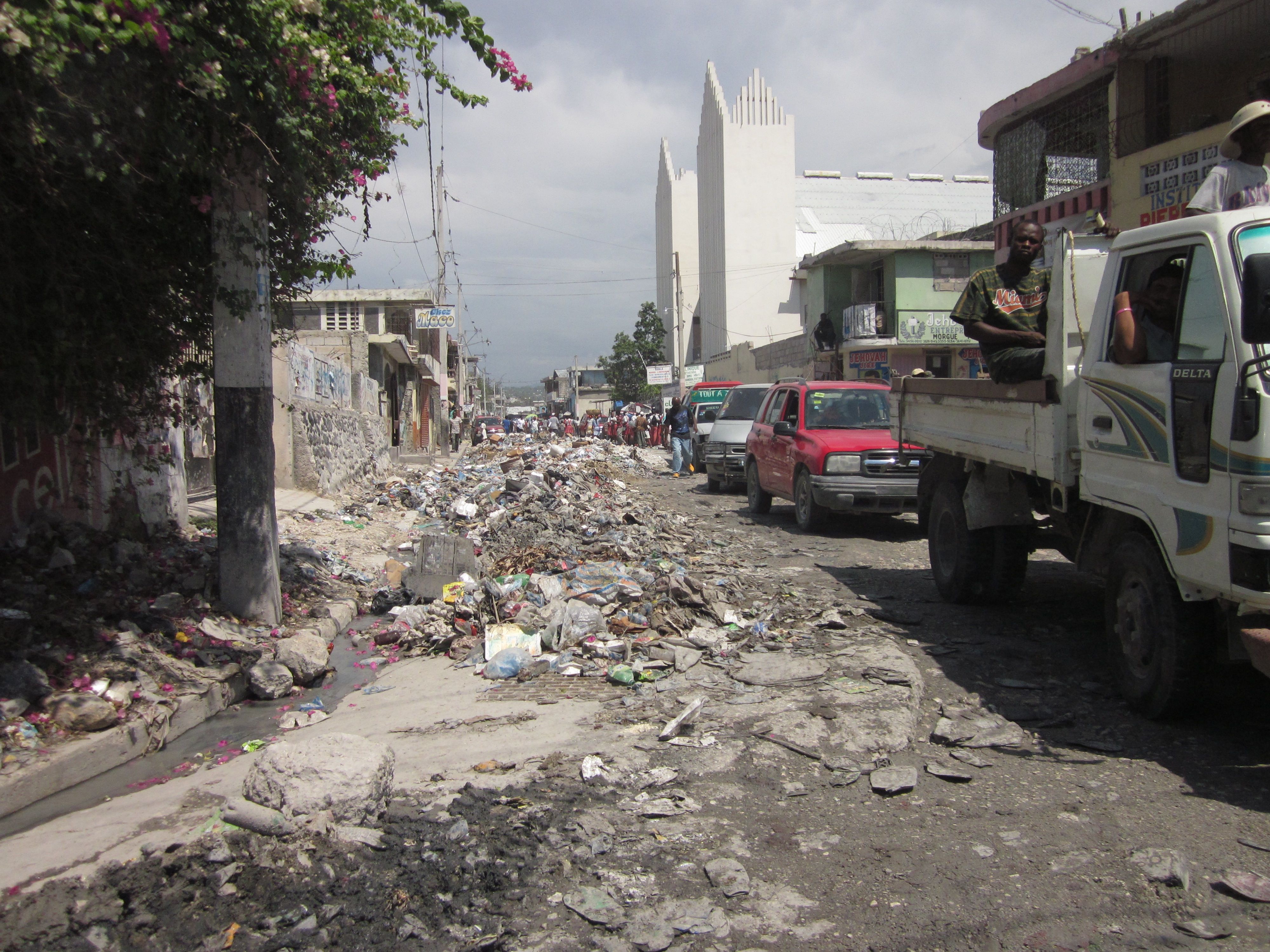
This pile of garbage in Port-au-Prince was three feet high and covered half the street for over 100 yards.
One of the most disturbing aspects of Haiti’s poverty during my visit was the horrifying abundance of plastic bottles, jugs, bags, wrappers, and more bottles. Here in the US, we have the infrastructure and the cultural education to haul our trash out of sight. Whether to a local landfill, China, or that swirling Texas-size pile of garbage in the Pacific, we have the means to rid ourselves of the petroleum-based packaging generated by our 1st world businesses. Haiti, lacking these means, has become mired in mountains of non-biodegradable packaging. In one corner of Port-au-Prince, there were large refuse containers actually steaming plastic fumes into the air, as the uncollected garbage composted itself.
Although the “Broken Window” theory undoubtedly has its limitations, I simply can’t believe that the filth, especially in Port-au-Prince, isn’t psychologically damaging to Haitian morale and sense of self-worth. Although people may live in extreme poverty, if their surroundings are clean, they can have pride in the home they maintain and the community they co-create. They can see the beauty around them. Engulfed in refuse, they are far more likely to feel that they subsist in an enormous garbage dump of an uncaring world, leading to emotions of hopelessness and resentment. Would you feel a sense of dignity if your front yard were covered in litter, and even if you piled it up, there was no where to put it? (Although, you could always dump it in your neighbor’s yard…).
This question has troubled me since my return. In speaking to a friend familiar with Africa, he was telling me that the same problem exists over there. Garbage isn’t the most pressing issue, but it has everything to do with the context people live in. For as long as 1st world businesses continue to benefit from using cheap plastic for the products they export, without concern or responsibility for the post-consumption fate of their product, 3rd world importing countries will continue to see their once beautiful surroundings sink deeper beneath a sea of garbage. This is another slice of the global context we are co-creating.
A very poor peasant hut in the Central Plateau -- trash is ubiquitous here as well, but this home gives a sense of the dignity of clean.
Posted in Reframe ReflectionsComments Off on Cleanliness is Next to Godliness
“This isn’t a life. It’s inhuman. Please tell people what you have seen here.”
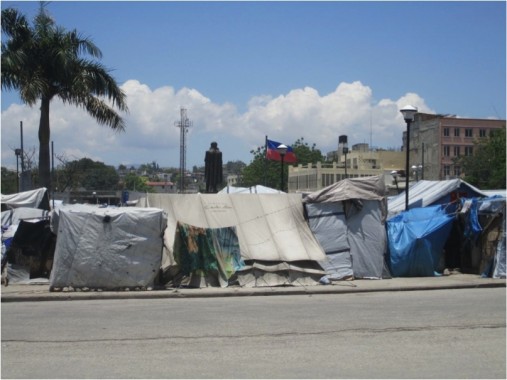
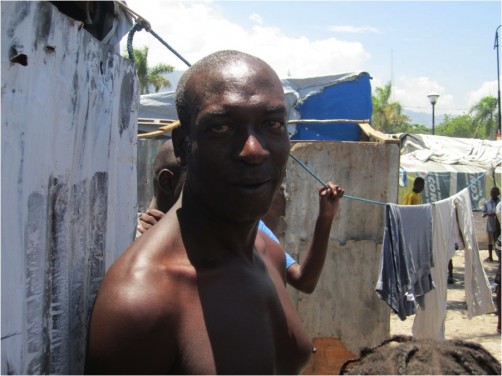
Jean-Yvon stares directly into my eyes with the self-assurance and dignity of a man who once earned a living to support his family. Today, he, his wife and their two children are sheltered in a twelve foot square makeshift tarp tent on the plaza across from the destroyed presidential palace in Port-au-Prince, Haiti.
I am here with two sisters, LeeAnn and Lorin, and Lorin’s Haitian husband, Jagat. LeeAnn is my colleague; her sister has been offering humanitarian support to several communities down here since just before the earthquake. Jagat translates when we don’t understand the Creole.
Jean-Yvon, however, speaks an educated and crisp French. His house was partially destroyed by the earthquake, and he doesn’t have the money to repair it. Only a small percentage of the millions of dollars donated by the international community after the earthquake has been distributed, so the poor, displaced people so many of us hoped to help are utterly without support. Trapped here indefinitely, Jean-Yvon serves as a spokesperson of sorts for the destitute group of families occupying the plaza. He walks us around, indicating what little water they have – too filthy to drink – and inviting us to take photos. “People need to know.”
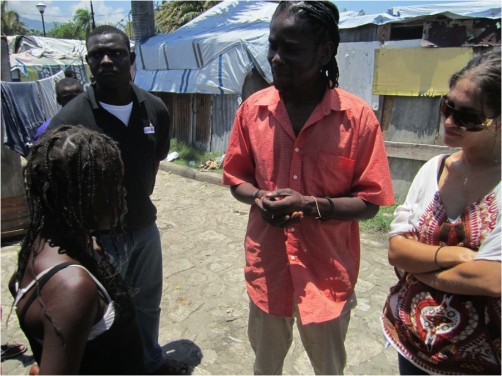
“You need to meet Annabelle!” he exclaims suddenly, grabbing us urgently by the arms. He leads us unerringly through a labyrinth of alleyways that has already disrupted my manly sense of direction. In moments, we are standing with a young woman who looks up at us timidly. “Go on,” Jean-Yvon says paternally, “tell them what happened to you.”
Annabelle is sixteen and her parents are both dead. She lives here with her stepparents, and had resorted to prostitution as the only way she could get food to eat. Some time ago, she was viciously attacked by a customer, and lay bleeding on the streets crying until finally people had come to help.
I can see her wound all too clearly as she speaks to us; the end of her tongue is missing. My whole body shivers with chills despite the brutal humidity.
Jean-Yvon is staring at me intently, friendly yet demanding. He doesn’t speak, but I can hear his voice as clear as the incessant blare of horns from the passing traffic: You see? It’s inhuman here. You need to tell the world.
So I’m telling anyone who will listen. I’m working to help any way I can. Haiti needs so much that even small gestures have a huge impact.
LaL’s CEO Shayne Hughes and Executive Coach LeeAnn Mallorie traveled to Haiti to meet with the community leaders of Savenette-Cabrale and the founder of the Compassion School. Participants in LaL’s March 2011 Personal Mastery seminar generously donated over $7300 to provide training, school supplies and clean water to this all volunteer school serving Haiti’s poorest children. The world needs us all to be acting to help others in accordance with our Noble Goals.
The tent camp just across from the destroyed Presidential Palace. The upcoming Presidential Inauguration will occur here and security officials are wondering what to do with the squatters.
Jean-Yvon.
Annabelle tells us her story. Jagat, in red, translates. Lorin is to his left.
I recently co-authored an article with Professor Jennifer Crocker of the University of Michigan on Barack Obama’s campaign for Presidency. It was published in Harvard’s Du Bois Review.
Fault Lines: Journeys into the New South Africa is a disturbing chronicle of the world of apartheid South Africa. Author David Goodman profiles eight people who engaged in and against the repressive regime. Barely part way through the second profile, I was deeply struck by how alcohol and addiction help us suppress our humanity.
We first meet Rev. Frank Chikane, a black anti-apartheid activist for decades and now a high level player in the post-apartheid government. He faces unthinkable atrocities with undaunted determination. I was humbled by his commitment and subsequent courage. Many willing white South Africans torture and attempt to kill Chikane over the years. One of them is Paul Erasmus.
Erasmus is the second person profiled by Goodman, and his story as perpetrator is far more disturbing than Chikane’s. An innocent young man progressively becomes an inhumane monster. If him, why not any one of us? I found myself cringing at every other page, and yet hearing Erasmus’ view of the world pushed me to empathize and identify with him. I’m curious, nauseous and moved to contemptuous judgment all at once. He’s not like me, I want to insist. He’s an aberration with no heart, no sense of humanity. How could anyone commit such atrocities?
Alcohol, that mundane indulgence so many of us enjoy, is the lubricant of his cruelty.
He and his comrades get drunk while they interrogate, because it helps them feel less inhibited; in the evenings, when their dirty work is done, they begin drinking in earnest, to wash away the guilt and remorse; the next morning, they are too hungover to know what they are feeling besides a pasty mouth and pounding head. And then the cycle starts again. They are completely disconnected emotionally from what they are doing — and without their emotions, they lose their humanity. They denigrate and rationalize. Apartheid was morally fortified with outrageous rationalization.
I am not on an anti-alcohol soapbox, but I am searching for the ingredients to a context for humanity. Studies have shown that ethical behavior does not come from intellectual values, because our human brain is so sophisticated and intelligent that we can justify and relabel almost any action we undertake. It is our emotional connection to other people that leads us to treat them humanely. Milgram showed us that the more distant the ‘learner’ was from the ‘teacher’, the more voltage the teacher would apply because s/he was not confronted with the emotional awareness of his/her actions.
Each of us does this every day, in different ways. We take the edge off the pain, the remorse, the failure, the conflict through our coping mechanism of choice. For years I drank and drugged to make the pain go away, to make life tolerable. It helped me to survive, but it also allowed me to not change — and not to confront the consequences I was having on others. When we eat, shop, smoke to excess, we numb ourselves, forgetting what has happened, how we feel about it, and what we might have done to contribute to it.
The founder of the company I work for, Claire Nuer, was a Holocaust survivor and was constantly challenging those of us around her to confront the little ways in our lives in which we contributed to or mirrored the greatest dramas in humanity. If she had been born German in Berlin in 1923 instead of Jewish in Paris in 1933, would she have been a Nazi? I complain about the intransigence of the Palestinians and the Israelis, but I too can be unbendingly righteous more often than I care to admit.
Well, the victimizers of South Africa buried their horror at what they did by drinking, and it allowed them to continue, until they went crazy or committed suicide. My actions are never egregious like theirs, but when I hurt others — my colleagues, my kids, my wife — I don’t want to feel the pain or face the shame of admitting it out loud. I want to make it go away, just like Paul Erasmus did.
So let your emotions rise, however painful or uncomfortable them way be. In them lies the very roots of your humanity.
I was privileged to spend a weekend last month in a conference with a small group of folks from all over the US exploring our dilemmas around race and gender relations. The seminar loosely followed the Nag’s Heart framework and participant backgrounds included African-American, Latino, bi-racial, foreign national, and a few caucasians (like myself, for example). I’d like to offer two takeaways that were significant for me.
Honoring Mistakes
We each presented a ‘dilemma’ — an issue or discomfort that we were facing in our relationships with people of other races, gender or sexual orientation. My line of work involves helping people identify the patterns of thought that hold them back in their lives. This can often take the form of challenging clients to question their views of other people and the world. When a situation involving race comes up, it is a delicate proposition for me as a white man to support, for example, African Americans to question how they are interpreting or reacting to the problem — not because they are closed to such reflections, but because it is more ambiguous coming from someone with my background (with all the historical and cultural meaning the color of my skin connotes).
I can fear in these moments (and I heard this concern echoed in different ways by other caucasians throughout the weekend) that I’ll inadvertently say something offensive (or be perceived as racist). We all internalize our cultural norms differently, but for me, being seen as a racist or an ignorant white person by an African American is on par with being morally wrong — and it would do irreparable harm to the relationship. There seems to be no room for a mistake in this arena. Simply look at how violent the reactions are in the media when an incident with racial overtones is exposed.
We came back to this tension a number of times over the course of the conference, and the last night one of the black members of the group shared a view that opened new space for me around the topic: “The test for me with a white person is how they deal with mistakes. Do they stay engaged? Do they care enough to take responsibility for it?”
Entering into a delicate race conversation with no room for error felt too much like high stakes gambling on impossible odds. Being able to stumble forward, and to stay in dialogue even if the communication derails — that I can do. I’ve made an uncountable number of mistakes in my life and have spent decades working on my ego defensiveness, so although I am certainly not perfect, I feel very grounded in my ability to recognize my responsibility or culpability in a conflict, even if it (gulp) were to involve race. This realization was primarily emotional; afterwards, I was thinking, “of course, that’s obvious.” But emotionally and behaviorally, it felt like a new operating paradigm.
Upon reflection, here’s the rub. What would it look like to acknowledge a misstep? To admit to ignorance or insensitivity — or even inadvertent racism (since we all have it)? Would I really have the courage? Would the other person really be able to stay in the dialogue with me, without throwing me away like a redneck rag? We are in a cultural paradox in which blacks often don’t feel acknowledged regarding the racism they experience, and yet whites would never be willing to admit to it, for fear of being shunned. We’re all miserable and disconnected; healing awaits us in our words.
White Guilt
The words ‘white guilt’ were tossed out in the middle of a sentence by one of the African-American members of the group, while describing an incident at work. I knew right away what it meant. A few minutes later, however, another member of the group asked for a definition — and three different participants offered three different explanations. All very real and personal, yet with divergent angles: historical guilt (eg, centuries of slavery), current day privilege guilt (eg, the majority of white people have fewer barriers to ‘success’ in modern America), and micro-interaction guilt (eg, ‘Oh my God, was that insensitive? Did I hurt their feelings? Should I say something? Would that just make it worse?’).
My feelings of white guilt are directly connected to a fear of blame. Like so many of our most pernicious unconscious behaviors, guilt has that great ability to make us feel really bad inside while masking the oh-so-comfortable benefits it provides us. (Depression is another powerful example of this ego mechanism). My white guilt allows me to feel pre-emptively repentant so that if you accuse me, I can defend myself with an “I know, I’m so terrible.”
The problem with guilt is that it allows us to abdicate, in good conscience, all co-responsibility. It supplants my sense of empathy with a black person regarding how difficult some of their experiences have been. I don’t actually engage them or their pain in a meaningful way; it becomes about me, instead of about them. Most of all, I have found that my guilt eventually leads me to lethargy. I may act for change for a while, but my yard stick of how much effort is ‘enough’ is whether or not my guilt has been assuaged — not the end result of racial equality.
I was struck again during this weekend how much potential healing and connection goes to waste in our lives. The painful feelings that we hold in boil and fester; we withdraw from the people, under the duress of a dramatic sense of threat; and yet, when we are able to create a communication space of safety and trust, even the most taboo topics are within reach.
I dislike television. I invariably have a profound feeling of squandering my time when I watch it, so for more than a decade I used mine only to watch movies. I’m embarrassed to admit that I actually paid for cable for years as part of my high-speed internet connection, but couldn’t be bothered to hook up the TV. With the stakes of this election season, however, I emptied my pockets to upgrade my cable so that I could have access to the cable “news” channels (Fox, CNN, MSNBC). With great anticipation, I skipped back and forth between channels, trying to absorb all the information and analysis of the primary season.
I ultimately landed on CNN because they seemed to really try to offer perspectives from both sides of the political divide. I kept an eye on Fox, so that I knew what Karl Rove was telling the right to think. And I avoided MSNBC because Keith Olbermann’s anger at Bush was simply too personal for me to feel like I was watching news (when I want anti-Bush vitriol, I call my mother).
As the weeks passed, though, so did my interest level. Soon, I could only bear to turn on CNN late in the evening of each primary contest, just long enough to catch the preliminary vote counts. I was confused: the hosts and guests all seemed intelligent, educated, “in the know”. Why weren’t they talking about anything useful?
Throughout the spring, for example, the focus was on the Clinton-Obama fight for the Democratic nomination. Each time I tuned in to CNN, they would re-explain the delegate count, with representatives of each side giving their opinion about whether Hilary could catch up; what the reactions and implications were of each new super delegate who endorsed Obama (especially if she or he were a Clinton loyalist); should Hilary stay in, will it hurt the Democrats; did I mention the delegate count… I can understand that we might want to pass over these topics briefly on our way to something meaningful, but I sat there in disbelief as they came back to the same topics after each commercial break with a different set of .
Then I would skip to Fox, where Sean Hannity has an annoying habit of interrupting his guests after he asks them a question. I find it very agitating, because we never actually get a chance to hear what they fully think. When I actually caught myself muttering under my breath “will you stop so he can finish?!” I realized that either I had become an irritable, out of touch old man like my grandfather (but at the tender age of 37) — or there was something terribly wrong with our media outlets.
Is this where most of America is getting its news and forming its opinions? Where is the average American supposed to go in this country to find a useful analysis of each candidate’s positions on the issues facing us today?I realized with a start that not only was I not learning anything useful about what each candidate might do about the Iraq War, the economy, the environment, education… I’d actually forgotten that these problems even existed. I was lost in a world of political soap opera distraction.
They couldn’t possibly be doing it deliberately, could they? A few months back on CNN, Larry King and Anderson Cooper did back to back hours on Christie Brinkley’s public condemnation of her husband’s infidelities. I was speechless. I couldn’t care less. I had to work very hard to resist the conclusion that there was somebody upstairs in CNN’s corporate headquarters with a master plan of public distraction.
If I don’t have the time to read whatever policy papers each candidate has outlined, I can’t listen to NPR during the day because I work for a living, and I lack the mental horsepower to get my news from the more intellectual publications like The Economist or the Atlantic Monthly, how am I supposed to make a thoughtful decision in this high stakes election? What choice do I have besides defaulting to my political affiliation or voting my gut instinct?
I want something different; I want an opportunity for a transparent, honest reflection that educates me on the problems and each candidate’s solutions. I want a far more thoughtful and in-depth discussion of what each candidate is really planning to do, when president, about all the major dilemmas we face. I recall listening to an analysis of one of the early Clinton-Obama debates, and the commentators were remarking with disapproval that we had spent too much time on healthcare (something like 15-20 minutes). The healthcare crisis is complex, outrageously expensive, dragging our economy down, ruining the lives of millions of people, only going to get worse – and 15 minutes seems like an unusually long amount of time to devote to it? I want a debate devoted just to healthcare, with non-partisan subject matter experts to critique the strategies of each candidate! Then maybe I’d understand why the system is so broken and who has the best chance of fixing it.
We need a forum that brings the candidates (or their vetted representatives) together in a vigorous, more detailed examination of our challenges. Every night, for an hour of primetime television, put the key elements of a given issue on the table and make the candidates come clean about what they really plan to do. Critique the ideas. Give me a chance to see how thoroughly each of them can back up their speech sound bites. And most of all, educate me, the average American voter.
The short list of pressing topics:
— The state of the economy. How would they regulate or not Wall Street? What are the short and long term fiscal implications of their tax proposals? What do they think about the current national debt and the weak dollar and how would they address it?
— The quagmire in Iraq. I know McCain wants to stay 100 years and Obama wants to get out. Hmm, can I have some more details? I think the war is a complete disaster and that every life (US and Iraqi) lost there is a tragedy. We need to end it. But if we just pull out, it’ll become like Afghanistan in the 90’s. So I’m not in either camp. I don’t know what these candidates are really planning to do.
— The destitute state of our international reputation. The US has fallen from the city on the hill to the overweight bully-buffoon. How do we restore our moral authority as a country?
— Dealing with Terrorism and the Middle-East. Obama proposes diplomacy, and talking to rogue nations (e.g., Syria, Iran). Bush and McCain call that pandering to terrorists — but their approach has clearly failed miserably. We can’t solve all our disagreements with the Mid-East/Islamic world with a gun; they obviously think very differently than we do about the world and our/their role in it. Is Obama too soft? Can McCain provide any diplomatic leadership? What is the alternative to either isolating or killing people (both techniques, by the way, if they fail, create more alienated terrorists)?
— The complete drought of funds and support for US veterans of Iraq (and other conflicts). The waiting lists for psychological treatment are years long and more veterans commit suicide upon return than die in combat. This is a drama! It’s unacceptable. There should be a national uproar! Whether I think the war is noble or a sham, these soldiers deserve to be healed and reintegrated into our society. I want a detailed proposal for how to help them.
— US Education. The immense amounts of money going into arms and the war, as our state governments (at least here in California) cut their education budgets, is maddening. This is not soft liberalism, this is hard-nosed business! We are gutting our ability to compete on the global marketplace by under-educating our children. If we don’t reverse this immediately we’ll join England in the club of ‘has been’ empires. Does either of our two candidates really have a plan behind their rhetoric?
— Oil dependence. It’s not just that we are inconveniently dependent on a very unstable area of the world, it’s that we are careening towards a global energy and food crisis — and we’re not talking about it.
— Re-establishing the lost integrity of agencies such as EPA, FDA, CIA, DOJ. They have been so corrupted by the political cronyism of the Bush Administration that they have suffered a cultural change as organizations. It’s not enough to just put a well-qualified leader at the top after inauguration. We actually need to reassert their right to be independent, to act in the best interests of the public welfare — to restrengthen their individual and collective commitment to the laws of the land. The baseline of what is “normal” needs to be methodically and radically raised by the next president or we’re going to become like all those corrupt 3rd world governments we read about in the newspapers.
— The environment. How are we going to address global warming? What kind of leadership are we going to provide? What is our specific plan? How will we work thru the impacts that it might have on our economy? What is our strategy for addressing the exponentially growing carbon footprints of China and India?
— Healthcare. What are the root causes of these untenable increases? What is the reality of each candidate’s plan? I still can’t figure it out behind all the spin. I would love to hear someone who is really knowledgeable about this complex industry help me understand the pros and cons of their respective plans.
— The immense control that special interest lobbies have in Washington. We are back to a pre-Theodore Roosevelt era of corporate influence of our government officials. Should we pass legislation to eliminate lobbying? Everyone, red and blue, is disappointed and cynical about Congress. Why is that and what do they need to change? We complain about the politicians, but we’d all do the same were we in that system. What are the root cause fixes that could help them lead with America’s best interests front and center?
As these ideas formed in my mind, I became excited about them. I imagined being really engaged in a dialogue about our future, with more fact and less spin. I even thought I could watch it with my children and get them thinking early about where we are going as a country. As luck would have it, I soon thereafter met a TV anchor at ABC news and I floated my plan to him. Surely he would see potential power of such a show, and he was even in a position to act on it!
He let me down gently but firmly: clearly, the public wasn’t interested in such details. No one would watch such a show. They want sound bites and then entertainment. I was a bit crestfallen. It’s true that I’m hardly the type to have an original idea. Someone else must have already thought of, and dismissed, a similar plan. Or perhaps during my decade of television abstinence, that’s even how the current cable news shows started before veering into their current absurdities.
But then I thought of the state of the world, and I offered him the only clarity I had left: if we don’t think we want it, somebody should tell us that we damn well need it.
So I pen this as an invitation and a challenge to our current cable networks: be patriotic, help us as Americans to knowledgeably think about these issues before it’s too late. Otherwise, you can count on one guy for sure cancelling his cable subscription on Wednesday November 5th.
I watched Obama’s speech Tuesday in Philadelphia on race. http://my.barackobama.com/page/content/hisownwords I was very moved by it and was in awe of his ability to name these racial and economic elephants so simply and truthfully. His ability to rise above the petty accusations and stay connected to his goal of leading our country to face our challenges is astounding. He reminds me of what I perceived to be Lincoln’s greatest strength (as described by Doris Goodwin in “Team of Rivals”): instead of defending himself, accusing others, and taking sides he really is able to rise above the fray and see others, the system, the larger purpose with clarity — and then somehow hold all those pieces in his head and communicate in common English.
I have worked incredibly hard on myself (my critical thinking, leadership, and systems analysis skills), for all of my adulthood — just so that I might blindly discern that such a clear vision exists. To challenge my assumptions, to see others behind their fight/flight behaviors, to grasp the system and dynamics behind seemingly random events/conflicts — and to do so when the stakes are so high… it’s not just that Obama is intelligent or brilliant (though true, those words aren’t appropriate); he is evolved, more conscious.
I’m of course putting him on a pedestal of sorts, and I’m sure he has his flaws, or loses his temper and clarity from time to time. But for him to have the insight, courage and eloquence to provide such a personal, powerful, and sweeping “state of race in the nation”, to create an opportunity from crisis, he irrefutably showed that he has the self-awareness, commitment and grasp of human nature needed to lead us.
After watching the speech on Tuesday evening, I turned on the news to see the reaction in the media. Overall, they did a hatchet job. I was outraged. If someone didn’t watch his speech in its entirety, and then simply caught the update on Fox news, they might simply conclude that he did a poor job of damage control. I perceived most of the main media channels to be focused on did he know, should he have known, he was spinning, he was lying, etc.
What Obama aimed to do on Tuesday was to help us heal, help us see each other, black and white, for the vulnerable, well-intended, contradictory creatures that we are — and to work together from that starting point. I don’t know what the media’s goal was. It wasn’t to help us move forward as a nation.
The recent announcement by the National Intelligence Estimate re: the Iranian’s plans (or lack thereof) to build nuclear weapons became, well, predictably partisan and laughable. The left called Bush a liar (or at best incompetent) and demanded his impeachment — again. The right backed Bush’s insistence that Iran might someday build a nuclear bomb, since it once had a program. A few reasonable voices pointed out that the Iranians stopped their program in 2003, perhaps due to the international pressure they were feeling at the time (proving the efficacy of such efforts). Apparently, 2 of the more than dozen US intelligence agencies abstained from endorsing the report, thus undermining the certainty that the information was probably true.
Then there were more amusing stories about how the timing and bluntness of the report were payback against Bush from the intelligence agencies for the humiliation they suffered for their faulty assertions that Saddam Hussein had WMDs. These I enjoyed the most.
But what do we really know from all of these reports? What can we be sure of? Shall we take a straw poll? Do they have nukes? They don’t? They have them in hiding and are trying to fake us out? They’re wanting to build nuclear power plants for domestic needs despite their oil richesse because they are deeply concerned about global warming? Hmm. I agree.
Learning from Iraq to Understand Iran
What struck me as profound and unnerving once we discovered that Iraq had no WMDs was the ‘true’ rationale behind Saddam Hussein stonewalling for so long against UN inspections: he was bluffing because he thought it would protect him from imminent invasion from the US and/or his neighbors. Wait, wasn’t his possession of WMDs our rationale for invading? What was he thinking? What was he smoking? Or was he just paranoid?
How is it that this line of thinking, what was really going on in his head, never once surfaced in the press or elsewhere as a possible explanation for his behavior? How could we have so deeply misread him? What can we learn from this costly incomprehension on our part?
The same thing that I would conclude from the recent intelligence report on Iran.
[Keep reading, it’ll come…]
A documentary on former Secretary of Defense Robert McNamara toured movie theaters a few years. It was called “Fog of War” and that’s how I feel now about Iran: in a fog. (I hope you do too, or you are seriously deluding yourself.) There are many fascinating threads to this documentary, but one in particular causes me great concern when I look at the world today. McNamara’s discusses his ‘Lessons of War’ and one of them is “Empathize with your Enemy.” Careful, all you hard-hearted, neoconservative war hawks, ’empathize’ does not mean ‘sympathize’. For that matter, all you warm and fuzzy, peace-loving, prius driving liberals should also be sure to look it up in the dictionary. Empathize means to put ourselves in the shoes of the other, and understand the world from their point of view. Walk in their skin, hear their demons, breath in their culture and national myths, see the rest of the world with their eyes.
We utterly failed at this with Saddam — and for the love of God, we are trapped too many years and too many thousands of deaths from the end of that mistake. We can’t win and we can’t leave, all we can do is to continue to pay the piper with human blood for not seeing the world and our enemies for who they were, for not understanding what drove them to act as they did. Shall we try it again with the Iranians? Dick Cheney appears ready.
The one key conclusion that we can draw with absolute certainty from the recent NIE report is that we don’t understand a damn thing about how the Arab-Muslim world thinks. We see the world as it makes sense to us, we interpret others actions as if we were committing them, we play our game of chess thru the prism of our national interests.
I believe everyone on both sides of the political spectrum should take note, because we won’t be able to either create peace or out-maneuver and effectively exploit without this empathy. We will simply be doomed act in ways that will backfire in our face because we had too little understanding of how the other side would respond. This isn’t about being nice, it’s about acting intelligently and wisely. We haven’t done that in years. How much longer do you think we’ll be able to continue and keep the upper hand?
 October 20, 2011
 Posted in Reframe Reflections
  Comments Off on A White Man’s Racial Stereotypes